Home FRP Pipes Pre-Insulated Pipes Manufacturing Joint Systems Installation Engineering Quality Control Experience Classification Contact Us


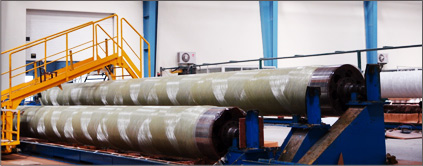
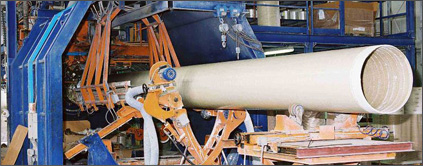
Dual helical filament winding is the process of impregnating pre-stressed continuous glass fiber roving with a matrix resin, then applying the wetted roving to a steel mandrel under controlled tension in predetermined winding angles using dual helical winding pattern, thereby achieving optimum mechanical properties in both the principal axis, longitudinal and circumferential. Depending upon the requirements of chemical resistance, mechanical properties and temperature resistance, a suitable resin is selected. The whole process is fully computer controlled. This unique manufacturing process enables the designer to select a system best suited to meet the specific end product requirements such as high strength, light weight, corrosion and weather resistance, low maintenance etc.

The steel mandrel on which the pipe is wound is solid type for nominal size upto 1000 mm and collapsible type for above 1000 mm. The mandrel is wrapped with a thin film of terphane (demolding agent). In case of pipes with Integral Socket, the tool for socket is checked and cleaned. If the socket is for rubber seal, the rubber mould for the groove is put in position.

The construction of the Inner liner, the internal resin rich chemical layer, varies with the type of the piping series selected. For GRE pipes, the structural wall is wound directly on a wet liner.

But for GRP/GRV pipes, the inner liner is gelled by infrared ray heaters to ensure precise resin content and maximum corrosion resistance. After the curing, a layer of glass impregnated with resin is wound on the liner to enable a good bonding between the gel coat and the helical winding.

For the construction of the structural wall, a carriage, supporting glass roving spool, roving impregnation bath and the automatic resin feeding, travels to and fro alongside the face of the mandrel. The movement of the carriage and the rotation of the mandrel are controlled by the computer. For each diameter, the machine has a program containing winding angles and the number of layers required. The angles at which the glass fibers are oriented in reference to the axis of the mandrel may vary from 0° to 90°. The ratio of axial stress to hoop stress in the pipe wall is linked to the winding angle. At 55° winding angle, the hoop stress will be twice that of axial stress. The greater the winding angle, the higher the hoop modulus of elasticity of the pipe. The tension of the roving is precisely adjusted to give the pre-stress required by the design of the pipe. For gravity pipes, silica sand may be used as filler for nominal size 400 mm and above.

After that the pipe is cured in the oven for one hour at 100°C. The pipe rotates during the curing to avoid uneven repatriation of the resin. After curing the pipe is demolded from the steel mandrel. The pipe ends are calibrated according to the requirements.

Nominal size ranging from 25 mm to 2600 mm is manufactured by this process.


Continuous Filament Winding process employs a steel mandrel whose surface is made up of a steel tape moving longitudinally with a speed depending upon the tape width and the cam plate. The steel band is elliptically wound on supporting beams placed along the grooved discs which is fixed on the mandrel shaft.

Before applying the raw materials, a special polyester film, mylar aiming to protect the surface and to make extraction of GRP pipe easier, is wound round the mandrel. Then a band of chemical resistant C glass, duly impregnated with resin, is applied. Being rich in resin (90%), it represents the chemical resistant wall of the pipe. The external layer also has the same characteristics as the inner layer.

The other two layers are applied between the inner layer and external layer. One is an anti-diffusion barrier, consisting of 70% resin and 30% chopped roving. The other is a mechanical resistant layer.

The thickness and composition of the mechanical resistant layer depends on the operating conditions the pipe shall withstand. Raw materials like resin, chopped roving, hoop roving and silica sand (if needed) in pre-determined proportions are fed on to the steel tape. As the steel tape moves forward longitudinally, the material on it also moves forward through four different heating zones having radiant heating units where the laminate gets cured. For each area, the heat to be supplied is controlled to maintain the required values of gel time, ISO-thermal peak and post polymerization in the oven.

Hoop roving supplies the required circumferential resistance of the pipe. Such roving, coming from the feeding systems through suitable tensioning device are wound circumferentially and continuously on the pipe wall.On the other hand, the chopped roving, 25-30mm in length, supplies an axial mechanical resistance which is the sum of axial resistance of each yarn.The silica sand has the scope to increase the wall thickness, and therefore the pipe stiffness without using a quantity of glass fiber higher than those foreseen by the design.

The resin represent the GRP composite matrix. It is applied by means of two basins providing to the suitable distribution through gauged holes. The resin delivered to the distribution basins is already mixed in the required percentage with catalyst. The distribution of the resin, catalyst and other raw materials is controlled by a numerical controller according to the mandrel speed.

Curing of resin is carried out in a polymerization oven equipped with infra red lamps installed on four different areas. It is possible to control the power supplied to each area in order to set the gel time, the isothermal peak and the post curing process according to the theoretical curing curve.

The production line is equipped with gauging and automatic cutting devices. The complete process is computer controlled. The pipe cutting at the required length is made by means of a diamond disc tool following the progress of the product.

Nominal size ranging from 250 mm to 4000 mm is manufactured by this process.


1 2 3 4 5 6 7 8
 
 
Home FRP pipes Pre-Insulated Pipes Manufacturing Product Range Installation Joint systems Engineering Experience Contact Us
 
  All rights reserved to ADPF , Best view in 1024*768 resolution. Flash 9.plugin required. An F1 Design.